I read a note from Simone Lenzu at the New York Fed for the first time on a Tuesday afternoon in early May. It is short, six or seven paragraphs of dense central-bank prose. The phrase that stopped me is two words long, centrifugal bind.
Lenzu uses it to describe a structural feature of how AI is currently being financed. The same expectations of future productivity that sustain elevated AI asset valuations are also what underwrites the debt being raised to build the infrastructure. Both halves of the system feed on the same unmeasured number. That is the bind.
I have been reading the underlying material since. The picture is sharper than the headline numbers suggest, and stranger than the dot-com analogies in my newsfeed.
A Curve, and the Numbers Behind It
In the third quarter of 2025, Microsoft spent $19.4 billion on property and equipment against $45.1 billion of operating cash flow, the cash the business generated that quarter. Alphabet spent $23.9 billion, which kept capex at 49% of operating cash flow that quarter. Meta spent $19.4 billion against $30 billion, a ratio of 65%. Amazon's trailing-twelve-month free cash flow fell from $47.7 billion a year earlier to $14.8 billion.
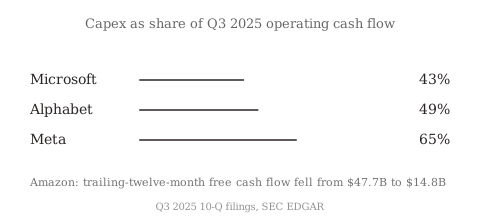
The Q1 2026 filings, released at the end of April, show the same shape rather than a reversion. Meta's ratio settled around 62%.
These are not bad balance sheets. They are extraordinarily healthy balance sheets running into the limits of what cash flow alone can fund.
The way to make sense of this pattern is older than the AI boom. In 2018, Erik Brynjolfsson, Daniel Rock, and Chad Syverson published a paper at the NBER that named the shape, the productivity J-curve. General-purpose technologies, they argued, require enormous complementary investments before any productivity shows up in the national accounts. The investments are real. The output is real. But the accounts do not connect them, because the intangible part (process redesign, new business models, human capital reorganisation) does not get measured the way physical capital does.
So firms appear, on the official numbers, to spend without producing. Then years later they appear to produce without spending. The J-curve is the gap between the spending and the measured output.
What changed in late 2025 is that the curve started being financed externally.
When capex grows beyond what operations throw off, the difference has to come from somewhere. Sometimes that means cash on hand. Sometimes it means bonds. Increasingly, it means structures that do not appear on the borrower's balance sheet at all.
The Plumbing Under the Spend
The most useful institutional voice on this is a March 2026 article in the BIS Quarterly Review by Egemen Eren, Ingomar Krohn, and Karamfil Todorov. They call what is happening shadow borrowing. Bond issuance by the hyperscalers (Microsoft, Alphabet, Amazon, Meta, the four largest cloud-and-AI companies) topped $100 billion in 2025, most of it long-dated. Lending by private credit funds to AI-related sectors has grown from near zero a few years ago to over $200 billion outstanding.
Then there is the part the BIS authors describe carefully. Dedicated vehicles, often joint ventures or special purpose entities, acquire or develop data centre assets, raise their own debt through private placements, and hold the hyperscaler as a minority equity partner. The hyperscaler commits to long-term operating leases or long-dated agreements to use the capacity the vehicle is building. The arrangement, in the BIS phrasing, "economically substitutes upfront capex with multi-year operating expenses while keeping most of the associated debt off the hyperscaler's balance sheet."
The cleanest example landed in October 2025. Meta's Q3 2025 10-Q discloses, as a subsequent event, a joint venture with funds managed by Blue Owl Capital to co-develop a data centre campus in Richland Parish, Louisiana. Meta contributed $4.3 billion in construction in progress and land at closing; Blue Owl contributed $7 billion in cash. Meta holds 20% of the venture, Blue Owl 80%. Meta committed to operating leases on the campus with an initial value of $12.3 billion over four years, with renewal options to twenty, and wrote a residual value guarantee that begins at $28 billion. The filing classifies the venture as an unconsolidated variable interest entity. Meta operates the asset. The debt the venture raises sits inside it, not on Meta's balance sheet.
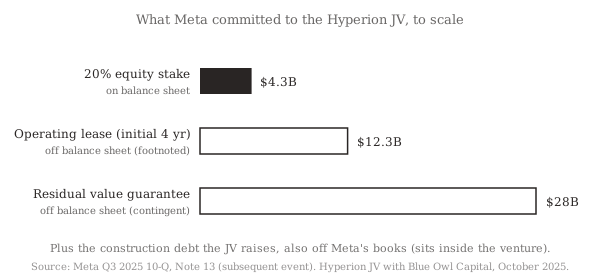
If you write down the obligations Meta has actually taken on, long-term operating commitments, performance guarantees, agreements to pay for capacity over years, you get something that walks and quacks like long-term debt. If you read the published balance sheet, you see equity in a joint venture. The BIS authors note this without drama, "obligations that are economically akin to debt but largely reside outside corporate balance sheets."
The buyer of that debt is mostly institutional. Insurance companies, pension funds, the private credit arms of large asset managers. They are buying a stream of payments whose ultimate source is the productivity that the AI investment is supposed to generate.
This is where the J-curve stops being a metaphor and starts doing structural work.
The Bind
Daron Acemoglu published a paper in 2024 called "The Simple Macroeconomics of AI." He uses a task-based model to bound, from first principles, how much total factor productivity AI can plausibly add. His upper estimate is that the next decade will add somewhere between 0.53% and 0.66% of total factor productivity in total. Across ten years that works out to about six hundredths of a percentage point per year.
The Bureau of Labor Statistics measures actual US labour productivity at 2.3% in 2024 and 1.6% in 2023. None of that is yet attributable, in any rigorous way, to AI specifically. The macro picture is one of healthy productivity growth from many sources, of which AI is currently a small one.
Acemoglu's estimate could be wrong. Most of the people raising capital against AI productivity certainly think it is. Goldman Sachs, McKinsey, and various house economists at the AI labs all forecast considerably higher numbers. Some of those forecasts come from researchers being paid by firms whose valuations depend on the higher number being right.
I am not in a position to adjudicate between Acemoglu and Goldman. What I can do is notice the shape of the bet that the financing architecture has already placed. The capex being committed in 2026, the debt being raised against future cash flows from data centres, the operating-lease commitments for capacity that does not yet exist, all of it is sized for a productivity number considerably higher than the Acemoglu upper bound. It is sized closer to the Goldman number.
Lenzu's centrifugal bind is what happens when the same forecast is doing two jobs. It is the basis for the asset valuations that make the capital cheap. It is also the basis for the debt service that makes the asset valuations sustainable. If the number arrives late, prices fall and the debt becomes harder to refinance at the same moment. If the number never arrives, the operating leases hyperscalers have signed get reabsorbed onto their balance sheets as the joint ventures fail to service the bonds.
Both halves of the system are running on the same forecast, and the forecast is uncertain by an order of magnitude.
The counter-argument is real and deserves its full weight. The borrowers here are not weak hands. Microsoft, Alphabet, Amazon, and Meta carry tens of billions in cash and have operating businesses that throw off enough free cash flow to absorb a great deal of disappointment. The debt is concentrated in firms of high credit quality. Productivity growth at 2% a year, AI-attributable or not, is genuinely strong by post-2008 standards. The dot-com comparison fails on the borrowers, those were equity-financed startups with no cash flow. The 2008 comparison fails on the holders, those mortgage-debt securitisations were retail-syndicated through bank balance sheets, not warehoused in private credit funds.
It is closer to a long-duration insurance product whose payout depends on a productivity forecast that will not settle for years.
The Bet Has Been Placed
Brynjolfsson's J-curve is real. The intangible investments going into AI now will, on his framework, show up in measured output later. The open question is whether later is six years or sixteen. Equity markets can wait six years more easily than they can wait sixteen. Operating-lease commitments can be refinanced over six years more easily than over sixteen. The shape of the financial architecture is well-suited to the shorter horizon and poorly suited to the longer one.
What I keep noticing is that the same forecast is being asked to underwrite both the optimism of the equity side and the discipline of the debt side. In most cycles those two are in opposition, keeping each other honest. Here, for now, they are aligned, and the alignment is the source of the bind.
The institutional voices have started naming what is happening. The BIS calls it shadow borrowing. The New York Fed calls it a centrifugal bind. The IMF's October report describes asset prices that could fall sharply if investor expectations about AI shift. They are pointing at a structure, and the point of pointing at it is that the structure has already chosen.
The capex spent, the bonds sold, the operating leases signed, the joint ventures capitalised, all of that has already committed to a productivity number that has not been measured. The bet is placed. The question worth holding is whether the productivity arrives in time, and what happens to the architecture if it does not.