Last week I spent an hour clicking around the digital edition of the Zettelkasten, the wooden box of indexed paper cards that the German sociologist Niklas Luhmann built and worked between 1952 and 1997. The University of Bielefeld put it online. The slip-box that produced seventy books and nearly four hundred articles is searchable now. The cross-references are hyperlinks. The wooden cabinet has become a database. It has not yet produced a seventy-first book.
I went looking for it because of a Brookings paper by Jacob Taylor and Kershlin Krishna that came out at the start of May. The paper proposes a diagnosis I think is right, and a remedy that I think skips a step.
The diagnosis first. Proprietary AI platforms capture, by default, what AI builders call the context (the running record of every interaction you have with them). Your prompts, your corrections, the documents you upload, the things you almost said and then deleted, all of it accumulates inside the vendor's database. You receive the single session. The platform keeps the history. You cannot query it, restructure it, export it in any meaningful way, or build on it across sessions except by linearly scrolling backward in a chat that becomes useless past a few hundred messages. The asymmetry is not ideological; it is engineered. Taylor and Krishna are right to call it out.
Their remedy is what they call context-maxxing. The term comes from the internet meme culture of compulsive optimisation, and is chosen with some irony. The substance is serious. The user manages their own hardware and software, an open-source agent harness, multi-provider API access, a personal knowledge base, and the supporting plumbing, and so "maximises" control of the context they generate. The architecture of deployment, the authors argue, not the model itself, determines whether the technology is expanding or eroding intellectual autonomy.
Here the paper makes a move whose friction is worth looking at. It cites Andy Clark and David Chalmers, who in 1998 published The Extended Mind in Analysis, and uses the extended-mind hypothesis to give philosophical weight to context-maxxing. If the mind genuinely extends into external artefacts when those artefacts are "appropriately coupled" with internal processes, then owning your cognitive architecture stops being a technical preference and becomes the condition of a mind that is not rented.
The question is what appropriately coupled actually means.
Four conditions
Clark and Chalmers are explicit about it. For Otto's notebook to count as part of his cognitive system, four conditions have to hold:
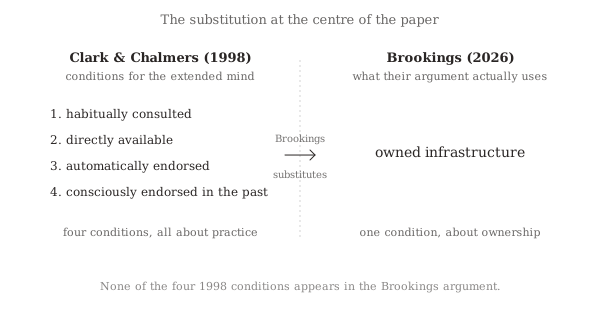
First, the notebook is a constant in Otto's life, in cases where the information in the notebook would be relevant, he will rarely take action without consulting it. Second, the information in the notebook is directly available without difficulty. Third, upon retrieving information from the notebook he automatically endorses it. Fourth, the information in the notebook has been consciously endorsed at some point in the past, and indeed is there as a consequence of this endorsement.
None of these conditions is about ownership. None of them is about who hosts the notebook, who legally controls it, who paid for the hardware. All four are about practice. The notebook has to be consulted habitually. The information has to be reachable without friction. Retrieval has to be automatic rather than deliberate. And the contents have to have been put there by the user in a conscious act, which is to say with the work of selection, reformulation, and indexing that turns a note into a note.
Brookings cites Clark and Chalmers, and then makes a quiet substitution. From appropriately coupled the paper slides to user-owned. The two are not the same thing. Ownership of the infrastructure may be one necessary condition of a certain kind of coupling. It is not that coupling.
Luhmann's Zettelkasten is the textbook case. It became, in his own description in Kommunikation mit Zettelkästen, a communication partner, and it became one because he worked it for over four decades. Cards were added, indexed, and cross-linked across the working years of an academic career, with each addition a small decision about what to keep and what to connect to what. The sustained work was not an operational detail of the system; it was the system. Take out the work and the Zettelkasten is a wooden cabinet.
Two axes, not one
The Brookings paper treats ownership of the infrastructure and cognitive agency as if they were the same thing, or two points on a single line. It is more useful to think of them as two independent axes.
The top-right corner of that grid is the one Brookings describes as the goal. High ownership of the infrastructure, high sustained practice. It is the corner of Luhmann. It is the corner the few people who have the time, the literacy, and the discipline to cultivate a personal context web over years end up in.
The three other quadrants are where the interesting questions live.
The bottom-right is the private silo. The user has configured the infrastructure. They own the context web. They do not live in it. Notes from six months ago sit where they were left. The knowledge base accumulates without being queried, and when it is queried the query is linear, the same way someone queries a proprietary chat. Ownership is formally complete. Cognitive agency does not increase. Friction does, because now there is also the job of being an administrator.
A disciplined user of proprietary tools lives in the top-left. They use Claude or ChatGPT every day with deliberate attention, hold their own framework in their head, come back to earlier reasoning, write in the margins, summarise, contradict. The platform captures the context. The user has the practice. Their mind extends, in some real measure, into a tool whose architecture they do not control. Brookings seems to suggest this position is impossible or unstable. The long history of intelligent use of tools one does not own suggests otherwise.
The market default sits in the bottom-left. No ownership, no practice. Brookings is right that this is the most common position and the weakest one. But you do not leave it by moving right. You also have to move up.
What context-maxxing actually costs
The political consequence of this distinction is something the paper brushes against and then drops. The five infrastructure blocks of context-maxxing require technical literacy, time, hardware, configuration and security overhead, and above all the daily cognitive discipline of feeding the personal context web. The investment is regressive. It gives more agency to people who already had free time, cultural capital, and access to compute.
Learning research on AI use is consistent with this. A randomised experiment by Fan and colleagues published in the British Journal of Educational Technology recruited 117 university students for a reading and writing task with four kinds of support: no support at all, ChatGPT, a human expert, and a writing analytics tool. The ChatGPT group's essays improved by 3.6 points on average. The no-support group improved by 1.6 points, the human-expert group by 1.5. The catch is in the second measurement. Knowledge gain on a delayed test was indistinguishable across conditions: 0.20 for no support, 0.19 for ChatGPT, 0.16 for the writing analytics tool, 0.14 for the human expert. The model improved the artefact. It did not improve the student.
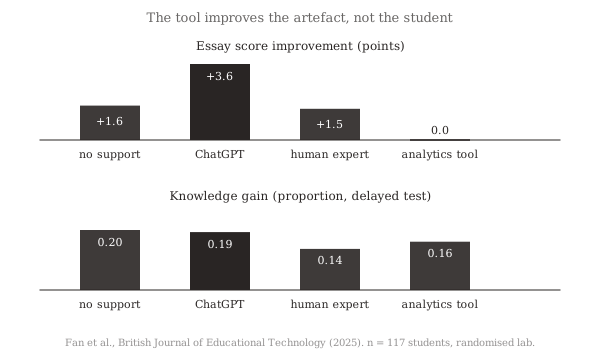
The study is one small lab experiment, not proof of a general phenomenon. But it points the same way as the Clark-Chalmers reading. The tool on its own does not build capacity. What builds capacity is the structure of the practice around the tool. Moving that infrastructure from the vendor's hands to the user's hands, without addressing the question of practice, redistributes the cost rather than solving the problem. The promise of democratisation stays a promise.
A methodological detail belongs in the same paragraph. Taylor and Krishna are explicit that the paper itself was written using the context-maxxing approach, with multiple model providers. The choice is internally coherent and also a little circular. A manifesto can carry that property without difficulty. An analysis that claims a correlation between architecture and cognitive agency should be able to point at the cases in which the correlation breaks. Those cases do not appear. What remains is a promising direction of work, not yet a measurement.
What is left
I do not think Brookings is wrong. The diagnosis is right, the direction is right, and naming an emergent phenomenon has value on its own. What I think is incomplete is the unit of analysis. Asking who owns the context is half the question. The other half is what practice is sustained with that context, who can sustain it, and for how long.
That second half changes the vocabulary in two places. It changes what an individual is buying when they decide to set up the stack, which is responsibility more than autonomy, and the useful question to ask in advance is how much of one's week one is prepared to invest in curating one's context, and what one intends to do with it once it reaches an interesting density. It also changes what public policy should fund if it takes the Brookings recommendation seriously. Infrastructure alone repeats the paper's error. What is needed is infrastructure and literacy, hardware and pedagogy, hosting and time. The public library is not only the building.
Owning the Zettelkasten is not being Luhmann. The cabinet works because something else worked alongside it for forty-five years, the small daily decisions about what to keep, what to link, what to push from fleeting to permanent. That something is what context-maxxing assumes and does not build. Without it, the most sovereign architecture in the world produces a private filter bubble in place of the vendor's, and a person mistakes the new feeling of administrative control for cognitive agency.
The Brookings paper describes the easy half of the problem well. The infrastructure half is real, it is mappable, and a workable answer to it now exists. The hard half is older than the paper, older than the generative model, older than the personal computer. It is the discipline of reading and writing one's way into one's own thinking, slowly, over years, with whatever tools are at hand. That discipline does not get easier when the tools get better. It only becomes easier to skip.